



Concept CWorking title

Tideline School

Out and back, and something to show for it.

Feels firstWonder

“What the tide brings.”

View the homepage concept

02

Positioning and proposition

Positioning

For Waiheke families who want their child’s days to have a shape, Tideline School is a one-room school starting with six children, whose day runs like a tide: out onto the land, back to the table, and something made from what was found.

One-line proposition

What the tide brings.

Organising idea
Out and back, and something to show for it. Each day goes out to the bush, garden or shore, comes back to the table, and leaves something made or recorded. The tide is the rhythm. The table of found and made things is the one room.
Promise, as a checkable commitment
Every day goes out, comes back, and leaves something you can see: a drawing, a found thing, a page in a main-lesson book. Once we open, we’ll photograph the table each week so you can check. [to confirm: weekly photo habit with teacher]
Personality
Curious · Calm · Precise.
Signature device
A hand-pressed wavering divider, and a grid of found and made objects laid out on the table and labelled like specimens. Why it is strongest as a device: the grid is a proof system as well as a style. Each week it shows real work from the real room. It turns “shown, not claimed” into a habit the teacher can keep up with one photograph a week.

Reasons to believe

  • NOWThe out-and-back rhythm is published (once written)
  • NOWThe plan to start with six children
  • ASSUMPTIONRegular, safe shore access (depends on: site and transport)
  • AFTERA weekly “table” photograph of made and found work
  • AFTERA seasonal and tide journal kept by the children

NOW can be shown or documented before opening. AFTER needs an operating school. ASSUMPTION depends on an open item.

How this concept shows the seven differentiators

Six to start, one room
The single table, top-down, as hero image
Different ages
Older and younger pairs sorting the day’s finds
Land as classroom
Lead message: out to bush, garden and shore, and back
Hands and mind and care (Steiner)
Drawing and recording what was found
Screen-free, rhythm-led
Lead message: the day as a tide table
Real work, real materials
Found objects, paper, pencil
Open to every family
Plain statement under the tideline
03

Manifesto

Twice a day the tide goes out, comes back, and leaves something on the sand. A shell. A feather. A piece of rope. A question.

Our days run the same way. Out to the shore, the bush and the garden. Back to the table to look closely, draw what we found, and make something of it.

The whole school at one table: six children to start, of different ages, on Waiheke. Time to notice. Time to ask why the weed lies in a line.

The seasons set the pace, and the tide keeps its own time.

Come for a morning and find out what the day brings.

Read aloud, this takes about a minute. Placeholders in brackets are details the school has not yet confirmed.

04

Lines to test and the name story

Lines to test

  • Recommended lineWhat the tide brings.Ownable, island-specific, implies discovery without promising an outcome. Strongest as a poster headline.
  • AlternativeOut and back, every day.Most literal about rhythm; used as the footer sign-off.
  • AlternativeNotice first.Shortest, but a sibling of “Ground first.” and may blur A and C in the vote. Test; don’t lead.

The name story, told at the gate

The tideline is the line of shell, weed and driftwood the sea leaves on the beach. It moves with every tide, and there is often something new on it. That’s our school day: out to the island, back to the table, something found and something made. It’s where land meets sea, and where an island starts.

05

Identity system

Wordmarks

The tide leaves a line, and the letters rest just above it, not quite level.

Tideline School wordmark, horizontal, in full colour
Horizontal · colourSVG
Tideline School wordmark, stacked
StackedSVG
Tideline School wordmark in one colour
One colour (stamp, screenprint, timber)SVG
Tideline School wordmark reversed on a dark ground
Reversed (dark-background test)SVG
How the wordmark is built
  • Construction. “tideline school” is set in Newsreader at opsz 72, weight 360, lowercase, tracked +12/1000, and outlined to paths. Lowercase keeps the mark quiet and editorial, and keeps it well apart from A’s heavy title case and B’s soft title case.
  • Baseline unevenness. Each letter is raised or lowered by up to ±2.2% of the font size (about ±1/20 of the x-height). The offset is read from a single “high-water” function made of three non-repeating components, so the rise and fall never settle into a regular wave. It is slight on purpose: the word reads as level at a glance and as hand-set when you look closer.
  • The tideline. It sits 0.18 em below the baseline and follows the same function, so the letters and the line clearly belong together. Its depth swells and thins between 2% and 4.2% of the font size. It is broken in two places, like a wrack line of weed and shell, and its ends taper to blunt points.
  • Linguist veto honoured. The ends taper straight and never curl. There is no spiral, no koru-like hook and no wave crest anywhere.
  • Colour version. Slate sea letters with a Kelp tideline, because the real tideline is a line of kelp. One-colour: all Slate sea, or any single ink. Reversed: Sand letters with a Shell line on Deep slate.

Stamp and avatar

Tideline School stamp: one colour, for lino, rubber or timber

Avatar and favicon

Tideline School avatar at 128 pixels128
Tideline School avatar at 64 pixels64
Tideline School avatar at 32 pixels32
Tideline School avatar at 16 pixels16

The avatar is the small-size fallback, tested at 32 px. Below the wordmark’s minimum size, use the avatar.

Palette and contrast

Contrast ratios are as recorded in the route’s visual-language file (WCAG 2.x formula, 5 November 2026). Swatches that fail for text are for surfaces and graphics only.

  • Aa#E6D8BF
    SandBase: brand surface, postersBase colourBase
  • Aa#F3EDE1
    SaltReading page (web body, letters)Base colourBase
  • Aa#3E5C64
    Slate seaLead colour: wordmark, headlines5.12:1Pass for textPass AA
  • Aa#2C454C
    Deep slateBody ink, reversed ground7.24:1Pass for textPass AA (and AAA on Salt)
  • Aa#E2B9A5
    ShellAccent: reversed tideline, large shapes1.28:1Not for textFails on light grounds. Never text on Sand or Salt. On Deep slate it gives 5.68:1 (pass)
  • Aa#4F5B3C
    KelpSecondary: the tideline, data lines5.16:1Pass for textPass AA. The only green in the three routes
  • Aa#A9A196
    DriftwoodNeutral: grid lines, specimen shadows1.82:1Not for textFails. Graphics only, and only next to darker elements

Reversed: Sand on Deep slate gives 7.24:1. Slate sea on Shell gives 4.01:1, which is large type only.

Rule: one accent at a time, Shell or Kelp, never both as competing highlights. Contrast was computed with the WCAG 2.x formula (Python, 2026-11-05).

Departures from the shared tokens
  1. Added Deep slate #2C454C for body text. Slate sea passes (5.12:1) but has little margin once printed on uncoated Sand.
  2. Added Salt #F3EDE1 as the long-reading page.
  3. Kelp demoted from core colour to secondary (the tideline and data lines only), so slate and shell lead. Kelp is now the only green across the three routes.
  4. Lowercase wordmark.
  5. Small caps replaced with tracked Public Sans capitals, because Newsreader has no smcp feature.

Type specimen

Display · Newsreader, light and calm

What the tide brings.

Out to the island. Back to the table.

Text · Public Sans

Boots off, bags on hooks, a handshake at the door. The whole school at one table: six children to start, of different ages, on Waiheke. Real work, in rhythm, with a teacher who knows each name.

Specimen sentences are set from the concept’s own words, as an example only.

Two families only: Newsreader (display) and Public Sans (text and data). Both are on Google Fonts under the OFL. IP counsel to confirm terms for signage and logo use.

No all-caps body. The brief suggested small caps, but Newsreader as served by Google Fonts has no smcp feature (checked in the font file on 2026-11-05), so tracked Public Sans capitals do that job.

H1
Newsreader 340, opsz 72 · 56 / 62 px
Light and calm: “What the tide brings.”
H2
Newsreader 380, opsz 36 · 34 / 42 px
H3
Newsreader italic 400, opsz 16 · 22 / 30 px
Body
Public Sans 400 · 16 / 24 px or 17 / 25.5 px (1.5)
60–72 characters a line
Data line
Public Sans 500, caps, +0.10 em, tabular figures · 12 / 18 px
Tide-table style: “LOW TIDE 7.42am · FOUND: 3 PODS”
Specimen label
Public Sans 500, caps · 11–12 px
“FOUND BY / ON”

Signature device

A hand-pressed wavering divider, and a grid of found and made objects laid out on the table and labelled like specimens. Why it is strongest as a device: the grid is a proof system as well as a style. Each week it shows real work from the real room. It turns “shown, not claimed” into a habit the teacher can keep up with one photograph a week.

The tideline and specimen grid, schematic

Schematic only. The finished device is drawn once and reused from the master files.

Rule / divider
It separates sections the way a beach separates zones. It always runs the full measure, has one or two breaks, and is never repeated in parallel (that would read as waves).
Frame
It is used only as a top or bottom edge. A specimen-grid photograph sits above the line, as if laid out at high water.
Stamp
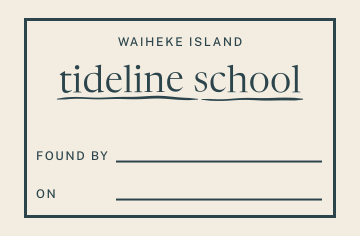
stamp.svg is a specimen label: WAIHEKE ISLAND, the wordmark on its line, then “FOUND BY ____ / ON ____”. Teachers press it on children’s found and made work, so the system itself becomes the weekly proof habit.
Sign edge
On timber, the line is routed or burnt in below the name, following the board’s own grain where possible. On the gate it can be a real rope-and-shell line at the foot of the sign.
Specimen grid
The main image system: found and made objects photographed from directly above on a pale table, in a 3 × 3 or 4 × 3 grid, each with a Public Sans data line (what it is, who found it, when).

Do

  • Keep the unevenness slight and fixed (use the master files)
  • Let the line taper and break
  • Use one tideline per section
  • Put body text in Deep slate on Salt or Sand
  • Show bush, garden and shore equally
  • Use the specimen stamp on real work every week

Don’t

  • Exaggerate it into bouncing letters, or make it a regular sine wave
  • Finish the line ends with curls, hooks or spirals
  • Stack several wavy lines (that reads as a surf brand)
  • Set text in Shell or Driftwood on light grounds
  • Make every image a beach
  • Use the stamp as decoration with no specimen
06

Moodboard

  • Rationale. The board has a large top margin and a centred header with a data line at its foot. Frames are small with generous gutters, each one hairline-mounted and numbered like a specimen. Wavering, hand-pressed tidelines divide the bands. Bush gets its own frames (02 and 09) to correct coastal bias. The specimen grid (frame 10) is the image system and the weekly proof habit.
  • Feels first: Wonder. The data line shows the school day (“out 9.00am · back 12.30pm”), never invented tide times.
  • Colour: Slate and sand lead, and Kelp is the only green on any board, used as an olive-brown secondary. Shell pink is for accents only (it fails contrast for text).
  • Veto applied: no spiral shells as motif (the specimen grid uses bivalves, pods, stones and tools), and no link from the name to any te reo place name. Frame 11’s crop must keep any spiral shell out of the focal point.

Photographs are concept stand-ins from Unsplash, each credited below. Every frame showing a child is a described frame, to be shot with consent. No stock child appears on any board.

Open full size
Photo credits (17)
  • Rock pools at low water: Rafael Peier, Unsplash · not Waiheke
  • Where the trees come down: Look Up Look Down Photography, Unsplash · appears under “Waiheke Island”, location [unverified]
  • The driftwood line: Hendro Susito, Unsplash
  • Ferry wake: Andy Watkins, Unsplash · not the Waiheke ferry
  • Into the grid: Photo: Johan Milson Kamaong, Unsplash · reference for the hand; the pencilled grid is for our commissioned shoot · concept image, not our school
  • Seaweed on herbarium paper: Photo: Europeana, Unsplash · a pressed land plant stands in for the seaweed; no label at the foot yet
  • Drawing what was found: Photo: Madeline Liu, Unsplash · leaves stand in for the pebble or shell
  • Small against the shore: Photo: Annie Spratt, Unsplash · closer than our brief; ours is shot wider, figures under 5% of frame · concept image, not our school
  • The track inland: Photo: Juliane Liebermann, Unsplash · European forest, not native bush · concept image, not our school
  • Down the garden rows: Photo: Paige Cody, Unsplash · concept image, not our school
  • The specimen grid: Photo: Elena Mozhvilo, Unsplash · a row, not yet our 3×3 grid; acorns are not island finds
  • The strandline as found: Bernd Dittrich, Unsplash · art-direct the crop so no spiral shell is the focal point
  • Bleached grain: Ty Rethy, Unsplash
  • Slate meets sand-printed paper: Photo: Rishi Saxena, Unsplash · the found version of the edge; slate and paper still to be made
  • The labelled plate: The New York Public Library, Unsplash
  • Overcast silver: Veronica Dudarev, Unsplash
  • Golden hour on water: Abyan Athif, Unsplash
07

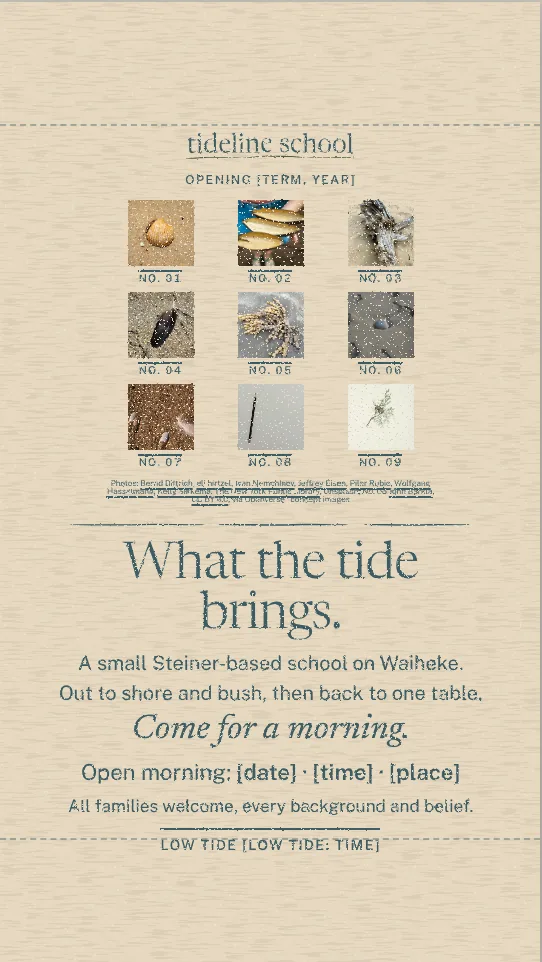
Poster

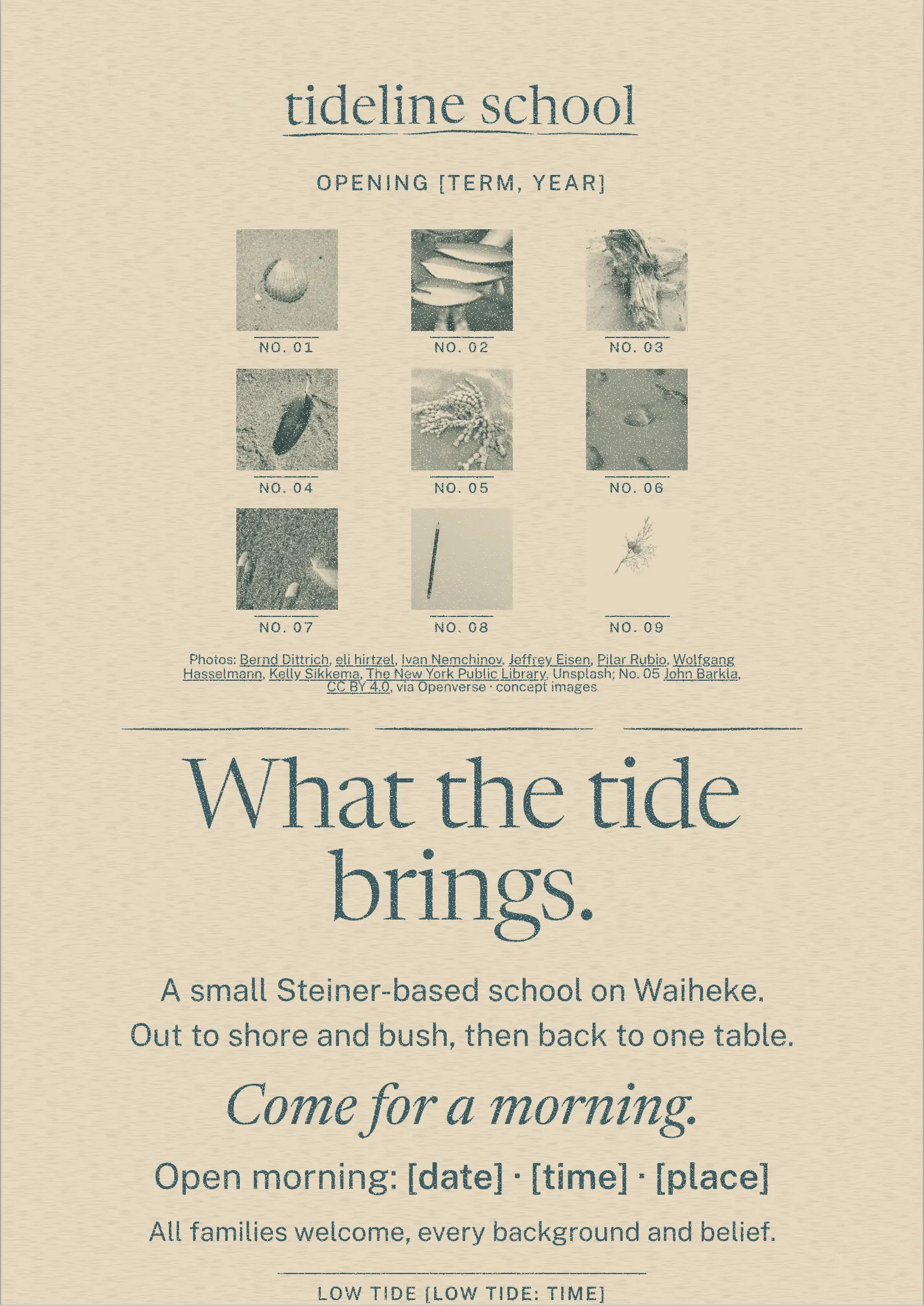
Tideline School A2 poster: What the tide brings. Come for a morning.
A2 poster420 × 594 mm, portrait. Select the poster for the full-size file.
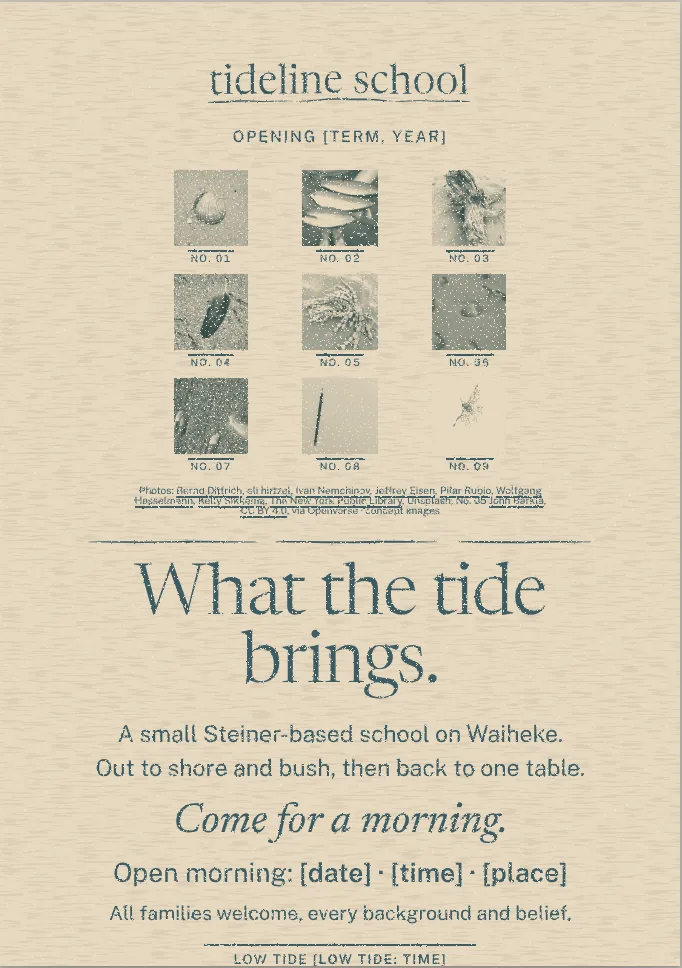
Tideline School A5 flyer: What the tide brings. Come for a morning.
A5 flyer148 × 210 mm
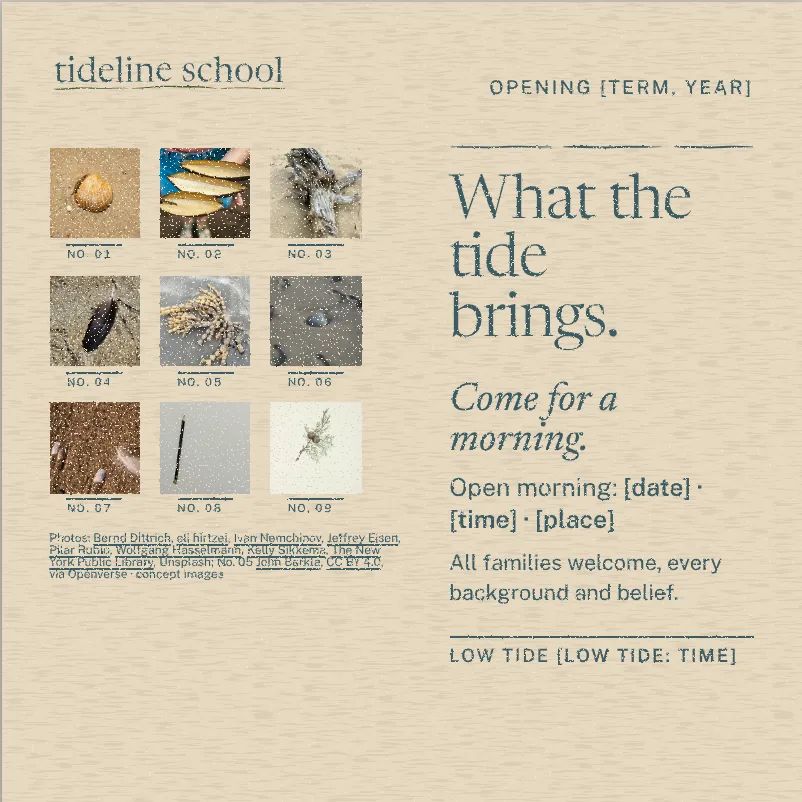
Tideline School square social tile: What the tide brings. Come for a morning.
Square tile1080 × 1080 px
Tideline School story format, 1080 by 1920: What the tide brings. Come for a morning.
Story1080 × 1920 px
Headline
What the tide brings.
Sub-line
A small Steiner-based school on Waiheke. Out to shore and bush, then back to one table.
Call to action
Come for a morning. Open morning:
Event line
[date] · [time] · [place]
Who we welcome
All families welcome, every background and belief.

The image areas are art-directed placeholders for a commissioned photograph. Placeholders in brackets are not yet confirmed.

08

Homepage concept

Desktop preview (1280 px wide)
Mobile preview (390 px wide)

The homepage carries a “decided / still confirming” panel and a status line, so a parent can see what is confirmed and what is still being set up. Placeholders in brackets stay visible on purpose.

09

Risks and open questions

These are the open risks and conditions on this concept, as recorded in the working papers. They are shown so that nothing is hidden before the vote.

Naming screen

No apparent conflict (preliminary).

  • No school with this name was found anywhere, and no NZ or AU education body or business called “Tideline”. The only commercial uses seen were overseas hospitality, in other classes.
  • A parent searching “Tideline Waiheke” today gets tide charts and dictionary entries, so the descriptor (“Tideline School, Waiheke”) and basic search work are needed.

This is a preliminary knockout screen, not a clearance search. The official registers (IPONZ, IP Australia, Companies Office) were not queried, so no name is cleared. A licensed trade mark attorney must check any name before it is adopted.

Source: preliminary screening, searches dated 5 Nov 2026.

Linguist and cultural vetoes

  • NO VETO; recommended strongest name linguisticallyTIDELINE (name). Risk: Low.
  • NO VETOTideline line and found-object grid (Route C device). Risk: Low.
  • VETO (conditional): lifts only on cultural adviceSpiral or koru-like form in any wordmark, symbol or pattern. Risk: Severe if used without advice.
  • VETO (conditional): lifts only after a mana whenua conversation supports it. The name TIDELINE itself is not affected. The copy makes no such link.Public link between the name and any te reo place name (route C name story). Risk: Moderate–severe.

Conditional vetoes cover how te ao Māori is used, not the English names. They lift only when the named condition is met, and they cannot be overridden by the creative team or the project lead.

Source: linguistic and cultural check, 5 Nov 2026.

Council risks

  • Social class: the highest of the three. A lowercase editorial serif, a gently drifting baseline, herbarium pages and overhead grids of found objects are the visual language of boutique hotels, design magazines and, on Waiheke, wine labels. The brief warns against exactly that SOC VA. The hero line “Out to the island” also reads as a visitor’s view, from the ferry inward SOC.
  • The table: on Waiheke, a long shared table shot from above is the image of the vineyard long lunch. If the table is clean, linen-covered and styled, the shared idea turns into a hospitality advert. This affects all three routes, and C most of all SOC.
  • Cultural: fact: in January 2021 Ngāti Pāoa placed a rāhui on scallops, mussels, crayfish and pāua around Waiheke. From 1 December 2021 it was made legally enforceable for two years, out to 1 nautical mile from the foreshore. An extension was proposed in 2024; its current status is [unverified]. A brand whose image system is collecting and labelling things from the shore, including mussel plates (frame 18) and bivalves in the grid, needs a mana whenua conversation before launch, not after ANTH. Numbering finds “No. 12” also echoes the museum taxonomy that removed taonga from Aotearoa ANTH.
  • Ecological: wrack is habitat. It feeds sandhoppers, which shorebirds eat, and studies overseas show that removing it lowers strandline biodiversity. That makes “draw it, leave it” ecologically right, not just a legal fallback BIO.

Source: Creative Council report (advisory only), 5 Nov 2026.

Factual corrections to the metaphor

  • “Twice a day”: acceptable as plain speech. NZ tides are semi-diurnal: on most days there are two highs and two lows, with an average cycle of 12 h 25 min (LINZ; MfE). On some days only three tides occur, so it is not every day. Keep the line.
  • “The tide keeps time”: wrong as written. High and low water arrive nearly an hour later each day (NIWA). The tide cannot keep a school’s clock. Proposed fix: “The seasons set the pace. The tide keeps its own time.” It is true, and the idea gets better for it.
  • The strandline is laid down at high water and seen at low water. A beach often has several lines: a faint one from the latest tide and a heavier one from the last spring tide or storm. “It moves every day, and there is always something new on it” (name story C.4) is only partly true. Proposed wording: “It moves with every tide and every storm.”
  • “The real tideline is a line of kelp” is partly true. On Gulf beaches the wrack is usually a mix of brown seaweeds, seagrass, shell, grit and litter: [unverified for the specific beach]. Say “weed and shell”.
  • The strandline is also where litter lands. The manifesto’s “a piece of rope” is honest. Do not polish that out.

Applied in the copy on this page: “The tide keeps its own time” and “It moves with every tide, and there is often something new on it.”

Source: Creative Council report, biologist’s read.

Claims still “OK once” (19 for this concept, including shared lines)

These lines stay in the mock-ups with their placeholders visible. None may be printed or published until the evidence is on file.

Show all 19 lines, with the evidence each one needs
  • S4“one teacher who knows each of them, and the land just outside the door”Status: OK once the teacher, staffing model and site are confirmed
    Evidence needed: Teacher appointed; adult-to-child ratio; site plan showing outdoor space next to the room
    Fallback: Fallback, as the platform notes already propose: “...and the land as part of every day.” Use it only once outdoor time is on the timetable.
  • S5“The whole school at one table”Status: OK once the descriptor and furniture are confirmed
    Evidence needed: (a) The legal pathway allows “school” (s 214; counsel). (b) The room and one table seat every child and adult.
    Fallback: If “school” cannot be used: “Everyone at one table” (as the verbal identity notes already set out).
  • S9“families are known in the room, not just at the gate”Status: OK once a family involvement rhythm is decided
    Evidence needed: Founder decision on how families take part (the platform notes mark it ASSUMPTION)
    Fallback: None while internal.
  • S10Inclusion statement “in line with the Federation’s published position”Status: OK once a person re-verifies the Federation statement
    Evidence needed: Read the Federation’s statement and record it with a date. Client copy never names the Federation.
    Fallback: None.
  • S11“Steiner-based”Status: OK once three conditions are met
    Evidence needed: (1) The Federation and a trade mark adviser clear use of the term. (2) A substantive basis: the teacher’s Steiner training is documented, or there is a written curriculum plan. Clearance of the word alone is not enough. (3) No line implies Federation membership or endorsement.
    Fallback: Fallback if not cleared: “drawing on Steiner education” in body copy only, never in a name or headline. If that is also not cleared, describe the practice without the term: “main lesson, rhythm and handwork”.
  • C1“Once we open, we’ll photograph the table each week so you can check.”Status: OK once the teacher commits and the image policy is written
    Evidence needed: The teacher agrees to the weekly habit; a consent and image policy (photograph work, not faces; Privacy Act 2020)
    Fallback: None. This is the strongest proof mechanism in the three routes.
  • C2“Twice a day the tide goes out, comes back...”Status: OK once a source is noted
    Evidence needed: LINZ tide predictions for the nearest standard port, recorded with link and date. On some calendar days there is only one low tide, which is acceptable as manifesto language.
    Fallback: None.
  • C4“The whole school at one table: six children to start, of different ages, on Waiheke.”Status: OK once S3, S5 and the ages are confirmed
    Evidence needed: Cap; descriptor; ages
    Fallback: None.
  • C6“That’s our school day: out to the island, back to the table”Status: OK once the site and timetable are confirmed
    Evidence needed: Timetable
    Fallback: If off-site outings are not timetabled: “That’s our day: out onto the land, back to the table...”
  • C7“A small Steiner-based school on Waiheke. Out to shore and bush, then back to one table.”Status: OK once the pathway, S11 and timetabled shore and bush access are confirmed
    Evidence needed: Legal pathway; site and transport; outdoor-education risk plan [data needed]
    Fallback: If there is no regular shore access: “A small school on Waiheke. Out on the land, then back to one table.”
  • C8“All families welcome, every background and belief.”Status: OK once the venue’s access is confirmed
    Evidence needed: As A10
    Fallback: None.
  • C9Tide-table data line (low-tide time)Status: OK once a source and reuse terms are recorded
    Evidence needed: LINZ predictions and their reuse terms (already flagged in VI)
    Fallback: [low tide: time] until sourced.
  • C10“Out to the island. Back to the table.”Status: OK once off-site outings are timetabled
    Evidence needed: Timetable; transport; consent; outdoor-education risk plan
    Fallback: Fallback: “Out to the land. Back to the table.”
  • C11Draft times; “10.45am Out: Shore, bush or garden, in turn”Status: OK once the timetable is confirmed (already labelled as a draft)
    Evidence needed: Final timetable; site; ratio and transport for shore trips; outdoor-education risk plan [data needed]
    Fallback: None. Keep the “draft” label visible in mock-ups.
  • C17“In this room, every child is equal.”Status: OK once the founder signs the statement
    Evidence needed: Founder approval
    Fallback: None.
  • C18“we’re working through [pathway] with the Ministry of Education”Status: OK once contact with the Ministry has started
    Evidence needed: As A21
    Fallback: As A21, in route voice: “Not yet. Here’s where things stand: we’re preparing to apply for [pathway, to confirm], and we haven’t applied yet. We’ll update this answer as it moves.”
  • C19“Ask us; we’ll answer plainly.”Status: OK once the fees are confirmed
    Evidence needed: Fee policy
    Fallback: If there is no support scheme, add: “We don’t have help with fees yet.”
  • C22“Bring a raincoat; we go out in most weather.”Status: OK once the open-morning plan includes time outdoors
    Evidence needed: Open-morning plan
    Fallback: None.
  • C23“Tideline School · Waiheke Island · Out and back, every day.”Status: OK once the descriptor and the timetable are confirmed
    Evidence needed: Pathway; timetable
    Fallback: If the descriptor is not cleared: “Tideline · Waiheke Island · Out and back, every day.”

Source: claims check, 5 Nov 2026. Most of the evidence depends on five founder answers: the legal pathway, the cap, the site, the timetable with hours outdoors, and the fee and access policy.

Other concepts

Back to all concepts