




Concept BWorking title

Connected School

Older teaches younger, at one table.

Feels firstTogether

“Joined by hand.”

View the homepage concept

02

Positioning and proposition

Positioning

For Waiheke families who want their child to be known by name, Connected School is a one-room school of fewer than ten children where children of different ages will learn side by side every day, and families are known in the room, not just at the gate.

One-line proposition

Joined by hand.

Organising idea
Older teaches younger, at one table. “Everything is joined” is too abstract. The joining a parent can watch is the room of different ages, so that becomes the idea.
Promise, as a checkable commitment
Once we open, your child will work beside older and younger children every day, at one table, and you’ll be able to know everyone in the room by name. Before then, come and meet us: see the room and the table, and ask how the day will run.
Personality
Generous · Open · Warm.
Signature device
One continuous line of real wool that crosses every layout. It shows relationship through a handwork material, not a network diagram. Watch: nodes and dots read as digital. Weaving and harakeke imagery need cultural advice, so no raranga-like patterns.

Reasons to believe

  • NOWThe single room of different ages (by design)
  • —A plain inclusion statement in line with the Federation’s published position (NOW. The Federation’s position is a fact in the brief and should be re-verified).
  • ASSUMPTIONA fee and access policy (depends on: [data needed: fees])
  • ASSUMPTIONThe adult-to-child ratio (depends on: staffing)
  • AFTEROlder and younger pairings documented in children’s work
  • ASSUMPTIONA family involvement rhythm

NOW can be shown or documented before opening. AFTER needs an operating school. ASSUMPTION depends on an open item.

How this concept shows the seven differentiators

Fewer than ten, one room
”Small enough to know everyone’s name”
Different ages
Lead message: “Older teaches younger”
Land as classroom
Shared bench or rope in a bush clearing
Hands and mind and care (Steiner)
Shared handwork such as knots, spinning, one project
Screen-free, rhythm-led
The rhythm as a thread through the week
Real work, real materials
Wool, rope, cloth
Open to every family
Lead message: strongest inclusion voice
03

Manifesto

Nobody learns alone.

Picture a six-year-old watching a ten-year-old tie a bowline. Next week she ties her own, and shows someone smaller.

That’s how we want our room to work. The whole school at one table: fewer than ten children, different ages. The older ones help. The younger ones ask. Everyone gets a turn at both.

A hand teaches a head. A walk to the shore turns into a lesson in counting. A morning song becomes a room that knows each other’s voices.

This is what we mean by connected: child to child, hand to head, school to island.

We keep it small so every child is known by name, and every family can know who is at the table.

Come and meet us. Bring your questions.

Joined by hand.

Read aloud, this takes about a minute. Placeholders in brackets are details the school has not yet confirmed.

04

Lines to test and the name story

Lines to test

  • Recommended lineJoined by hand.Turns “connected” from wifi into hands in three words. Pairs with the wool-thread device.
  • AlternativeSmall enough to know you.Warmest, plainest; weaker distinctiveness. Used, extended, as the hero headline.
  • AlternativeOlder and younger, one table.Owns the room in plain words, carries scale. Less emotional.

The name story, told at the gate

Connected usually means wifi. Here it means people. A younger child learning a knot from an older one. A teacher who knows every name [to confirm: teacher]. The whole school at one table, and families who get to know each other at the gate. We use the word on purpose, and we mean it by hand.

05

Identity system

Wordmarks

One thread joins the c to the t and becomes its crossbar, so the letters hold each other up.

Connected School wordmark, horizontal, in full colour
Horizontal · colourSVG
Connected School wordmark, stacked
StackedSVG
Connected School wordmark in one colour
One colour (stamp, screenprint, timber)SVG
Connected School wordmark reversed on a dark ground
Reversed (dark-background test)SVG
How the wordmark is built
  • Construction. “Connected School” is set in Fraunces at SOFT 100, WONK 0, opsz 72, weight 420, title case, tracked +10/1000, and outlined to paths. The c–t pair is opened by 0.035 em. One thread, drawn as a single stroke with round caps, starts inside the c’s shoulder. It crosses the gap with a gentle sag, as a real thread does between two points, and runs on as the t’s crossbar. Its depth equals the t’s own crossbar (108/2000 em), so in one colour it reads as a true ligature. In colour, the thread is Madder and the letters are Indigo.
  • Why c–t. It sits at the centre of the word, and its two letters differ in size (a round, low c and a taller t), just as an older and a younger child do. The joined pair also gives the route an ownable avatar. Fraunces has no ct ligature of its own; this one is drawn new.
  • Why a sag. A taut straight line reads as a diagram, and nodes or dots read as digital. The slight sag is the one detail that says thread.
  • Linguist veto honoured. There is a single line, no interlacing, no plait, no grid, no crossing and no knot, and nothing that resembles raranga, harakeke, tukutuku or whiri. The stamp frame is also one open line that never crosses itself.

Stamp and avatar

Connected School stamp: one colour, for lino, rubber or timber

Avatar and favicon

Connected School avatar at 128 pixels128
Connected School avatar at 64 pixels64
Connected School avatar at 32 pixels32
Connected School avatar at 16 pixels16

The avatar is the small-size fallback, tested at 32 px. Below the wordmark’s minimum size, use the avatar.

Palette and contrast

Contrast ratios are as recorded in the route’s visual-language file (WCAG 2.x formula, 5 November 2026). Swatches that fail for text are for surfaces and graphics only.

  • Aa#F5EFE3
    CreamBaseBase colourBase
  • Aa#2E3F5C
    IndigoInk, body text9.25:1Pass for textPass (AA and AAA)
  • Aa#A8473A
    MadderAccent: the thread, links, labels5.06:1Pass for textPass AA
  • Aa#D8C7A0
    Flax (token renamed “Oat”)Secondary surface1.46:1Not for textFails. Surface only (Indigo on Flax 6.36:1; Madder on Flax 3.47:1, large type only)
  • Aa#A9B6C8
    WoadTint surface, for quiet panels1.80:1Not for textFails. Surface only (Indigo on Woad 5.15:1)

Reversed: Cream on Indigo gives 9.25:1. Never put Madder on Indigo (1.83:1). On Indigo the thread turns Cream, which gives the one-colour ligature.

All five colours come from natural dyes used in wool handwork: indigo, madder, woad, undyed flax. Contrast was computed with the WCAG 2.x formula (Python, 2026-11-05).

Departures from the shared tokens
  1. The shared green is not used. This route has no green.
  2. Added Woad #A9B6C8 as a quiet tint surface, still within the natural-dye logic.
  3. Wordmark in Fraunces roman, not italic: it is more legible on timber and at 32 px. Italic is kept for H1 and H3, where the brief asked for warmth.
  4. Axes fixed at SOFT 100 and WONK 0 for the whole system.

Type specimen

Display · Fraunces, soft, italic for the warm voice

Small enough to know you.

Older and younger, one table.

Text · Source Serif 4

Boots off, bags on hooks, a handshake at the door. The whole school at one table: fewer than ten children, of different ages, on Waiheke. Real work, in rhythm, with a teacher who knows each name.

Specimen sentences are set from the concept’s own words, as an example only.

Two families only: Fraunces (display; variable, SOFT 100 and WONK 0 always) and Source Serif 4 (text, variable with optical sizes). Both are on Google Fonts under the OFL. IP counsel to confirm terms for signage and logo use.

No all caps. Never set WONK on: its leaning n and h read as quirky, not warm.

H1
Fraunces italic 400, opsz 72 · 52 / 58 px
The warm voice: “Small enough to know you.”
H2
Fraunces roman 450, opsz 48 · 34 / 40 px
H3
Fraunces italic 400, opsz 24 · 24 / 30 px
Body
Source Serif 4 400, opsz auto · 18 / 27 px (1.5)
Long reading, 60–68 characters a line
Label
Source Serif 4 italic 500 · 14 / 21 px
Madder allowed (5.06:1). Small caps (smcp) available for dates
Hand thread
Drawn or real wool · —
Underlines and links: one line only

Signature device

One continuous line of real wool that crosses every layout. It shows relationship through a handwork material, not a network diagram. Watch: nodes and dots read as digital. Weaving and harakeke imagery need cultural advice, so no raranga-like patterns.

The thread, schematic

Schematic only. The finished device is drawn once and reused from the master files.

Rule
One continuous Madder line per page or spread, never more. It may enter from an edge, pass under a headline, and leave. It sags slightly between the things it joins. Stroke: 2.5 px on screen, 1 pt in print.
Frame
One open line round a label, starting and ending at a gap that holds a short piece of text (see stamp.svg). It never closes, crosses or loops.
Stamp
stamp.svg: a rounded label made of one thread, with the name inside and “Waiheke Island” sitting in the gap. One colour.
Sign edge
A real wool or cotton cord stapled along the top edge of the timber sign, leaving and rejoining the board, with the ct ligature routed into the board.
Web
Links and the “Meet us” button are underlined by a short sagging thread. No animated drawing of the line (no motion that reads as a loading bar).

Do

  • Use one line that travels and joins
  • Let the thread sag a little between two points
  • Keep the thread at the t-crossbar depth in the mark
  • Use Madder for one accent per layout
  • Show cord, wool and cloth as plain materials
  • Redefine “connected” as human in every headline

Don’t

  • Draw nodes, dots, dashed connectors or network diagrams
  • Pull it ruler-straight or coil it into a spiral
  • Thin it to a hairline or thicken it into a ribbon
  • Put Madder text on Indigo or Flax at small sizes
  • Show any interlace, plait, weave grid or raranga-like pattern
  • Use “connect”, “network” or “link” in a digital sense
06

Moodboard

  • Rationale. One continuous madder thread runs behind the whole page. Frames overlap and step down like layers of felt instead of sitting in a grid. Every hands and children frame shows two or more people on one task at different heights. The light is soft window light on a single shared table.
  • Feels first: Together.
  • Colour: Indigo and cream lead, Madder is kept for the thread, and there is no green, so B reads blue-red. Token “Flax” is renamed “Oat” (same #D8C7A0) to avoid any harakeke reading. This is a documented token change.
  • Veto applied: no raranga, harakeke, tukutuku or plaited patterns. The loom in frame 04 is a European floor loom, but someone must look at the image before the parent evening.

Photographs are concept stand-ins from Unsplash, each credited below. Every frame showing a child is a described frame, to be shot with consent. No stock child appears on any board.

Open full size
Photo credits (16)
  • 01 · One table, in the bush: Photo: CARMELA LUSTRE, Unsplash · stand-in: not native bush, not our site
  • 02 · A rope between two trees: Photo: Compagnons, Unsplash · sisal-type rope, not harakeke
  • 03 · One knot, four hands: Photo: Maheima Kapur, Unsplash · stand-in for the relationship (clay, not wool) · concept image, not our school
  • 04 · The skein, before winding: Photo: Bernd Dittrich, Unsplash · replaces the earlier loom frame (Council flag)
  • 05 · Spinning: Photo: Taras Zaluzhnyi, Unsplash · adult maker · concept image, not our school
  • 06 · Side by side, four heights: Photo: Piron Guillaume, Unsplash · bench, not table · concept image, not our school
  • 07 · The older one reads aloud: Photo: Nils Huenerfuerst, Unsplash · cropped · a street book box, not a main-lesson book · concept image, not our school
  • 08 · Undyed and dyed: Photo: Anastasia Zhenina, Unsplash
  • 09 · The shared basket: Photo: K Adams, Unsplash
  • 10 · A skein, close: Photo: Edo, Unsplash
  • 11 · The dye line: Photo: Anna Ansone, Unsplash
  • 12 · Rope, close: Photo: Uliya Kurilova, Unsplash · twisted, not braided (replaces a braided-rope frame)
  • 13 · Figure-eight: Photo: A.Rahmat MN, Unsplash
  • 14 · Felt, overlapped: Photo: engin akyurt, Unsplash · one panel, close; the overlap is for our shoot
  • 20 · Table by the window: Photo: Hale Tat, Unsplash
  • 21 · Lines of light: Photo: Bree Anne, Unsplash
07

Poster

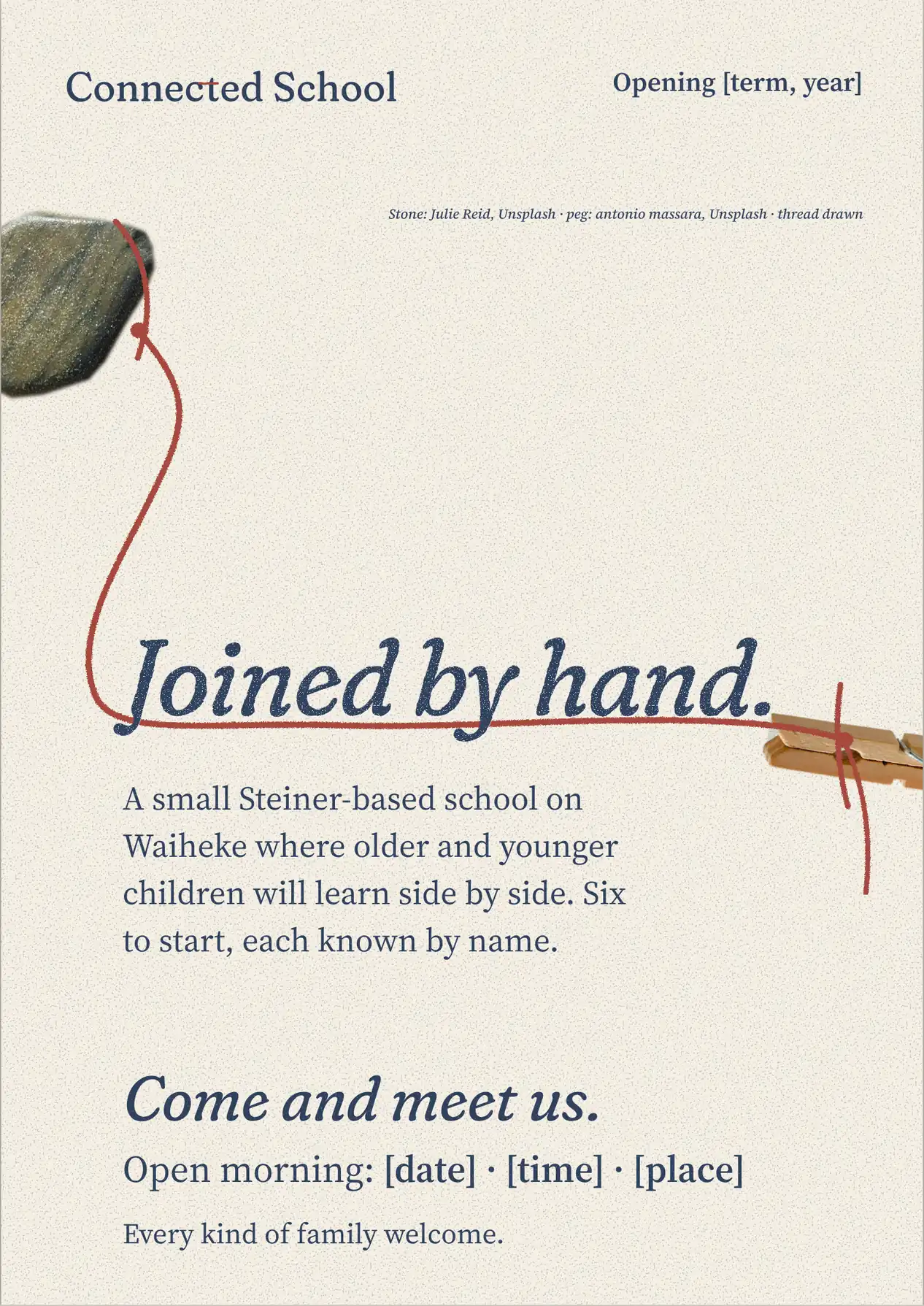
Connected School A2 poster: Joined by hand. Come and meet us.
A2 poster420 × 594 mm, portrait. Select the poster for the full-size file.
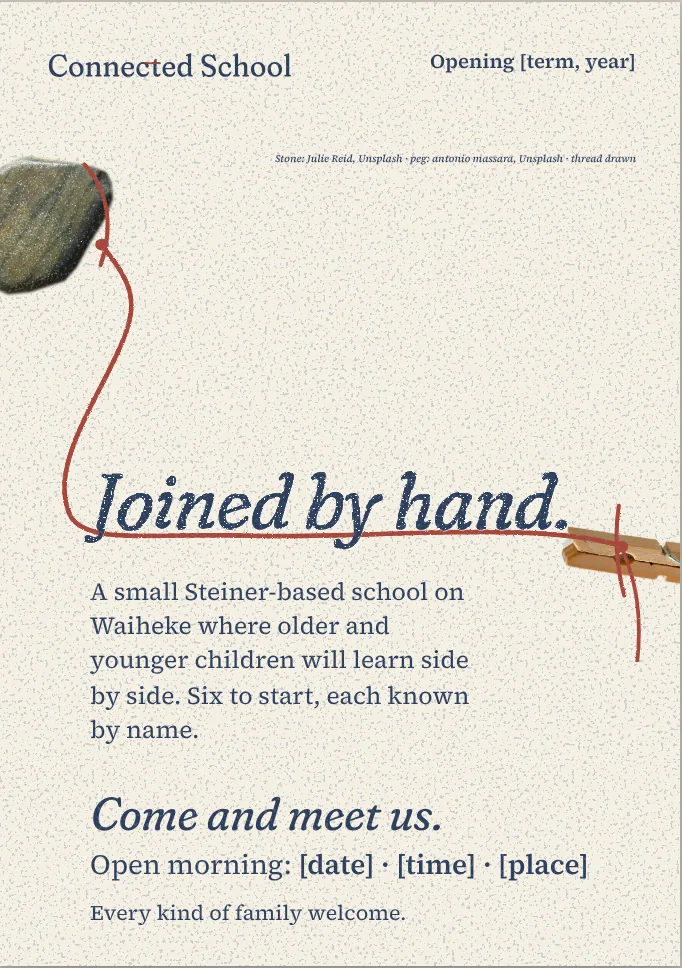
Connected School A5 flyer: Joined by hand. Come and meet us.
A5 flyer148 × 210 mm
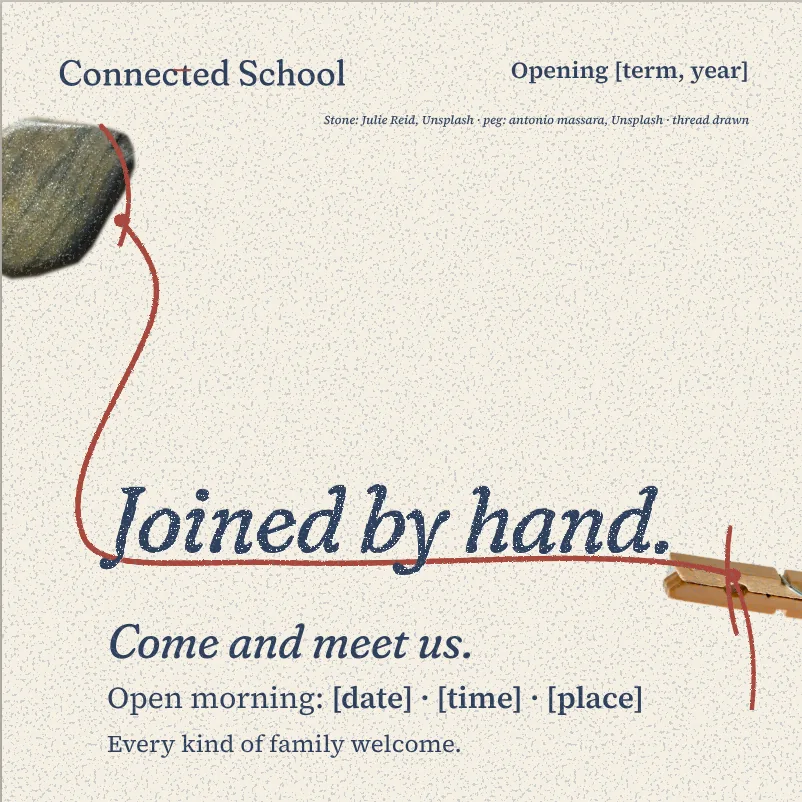
Connected School square social tile: Joined by hand. Come and meet us.
Square tile1080 × 1080 px
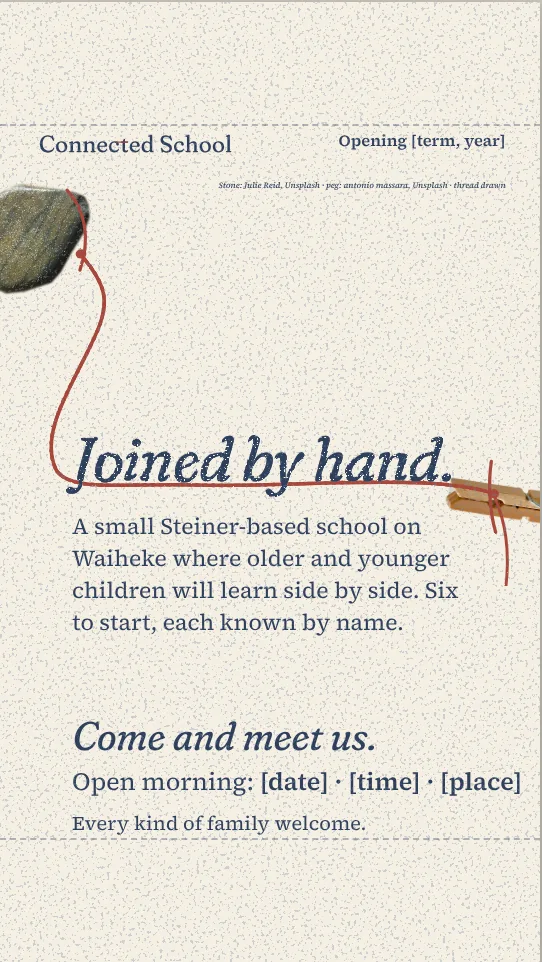
Connected School story format, 1080 by 1920: Joined by hand. Come and meet us.
Story1080 × 1920 px
Headline
Joined by hand.
Sub-line
A small [Steiner-based] school on Waiheke where older and younger children learn side by side. Fewer than ten, each known by name.
Call to action
Come and meet us. Open morning:
Event line
[date] · [time] · [place]
Who we welcome
Every kind of family welcome.

The image areas are art-directed placeholders for a commissioned photograph. Placeholders in brackets are not yet confirmed.

08

Homepage concept

Desktop preview (1280 px wide)
Mobile preview (390 px wide)

The homepage carries a “decided / still confirming” panel and a status line, so a parent can see what is confirmed and what is still being set up. Placeholders in brackets stay visible on purpose.

09

Risks and open questions

These are the open risks and conditions on this concept, as recorded in the working papers. They are shown so that nothing is hidden before the vote.

Naming screen

Potential, high practical risk.

  • No single legal blocker was found in NZ.
  • In NZ school search results the word belongs to digital connectivity (the Crown’s schools network and Ministry programmes). It is also used generically in education, and a near-identical name is used by a school cluster in Australia.
  • A screen-free school would be hard to find online under this name, and the name would be weak to protect.

This is a preliminary knockout screen, not a clearance search. The official registers (IPONZ, IP Australia, Companies Office) were not queried, so no name is cleared. A licensed trade mark attorney must check any name before it is adopted.

Source: preliminary screening, searches dated 5 Nov 2026.

Linguist and cultural vetoes

  • NO VETO; not recommended as the lead nameCONNECTED (name). Risk: Moderate (meaning contradicts the screen-free promise in NZ education).
  • NO VETOThread in wool/cotton (Route B device). Risk: Low.
  • VETO (conditional): lifts only on written cultural advice / mana whenua supportWeave visuals that resemble raranga, harakeke, tukutuku or whiri patterns. Risk: Severe if used without advice.
  • VETO (conditional): lifts only on cultural adviceSpiral or koru-like form in any wordmark, symbol or pattern. Risk: Severe if used without advice.

Conditional vetoes cover how te ao Māori is used, not the English names. They lift only when the named condition is met, and they cannot be overridden by the creative team or the project lead.

Source: linguistic and cultural check, 5 Nov 2026.

Council risks

  • Name: the N4L / Te Mana Tūhono collision is well documented by the linguist. The Council adds nothing new and agrees.
  • Steiner stereotype: the highest of the three. Plant-dyed wool, madder and indigo, felt, knitting, a morning circle with every name said aloud, and a loom: together they look like a Waldorf craft shop VA SOC.
  • Social class: moderate. A plant-dyed, hand-spun palette signals price, because these are expensive craft materials SOC.
  • Cultural / internal consistency: moodboard frame 04 shows “a woman weaving fabric on a floor loom”. The linguist’s veto covers raranga-like visuals, not every loom. But the verbal identity notes ban “weave, weaving… imagery or wording” for this route, so the board breaks the route’s own rule ANTH.
  • Craft: below about 120 px the sag of the thread is invisible, and the mark then reads as an ordinary ct ligature VA.

Source: Creative Council report (advisory only), 5 Nov 2026.

Factual corrections to the metaphor

  • The brief lists “root system” as a B image. Keep it out. Popular claims that trees share resources and “talk” through fungal networks are contested in the peer-reviewed literature (Karst, Jones & Hoeksema 2023, with a 2025 rebuttal from Simard et al.). The current copy does not use it. Keep it that way.

Source: Creative Council report, biologist’s read.

Claims still “OK once” (17 for this concept, including shared lines)

These lines stay in the mock-ups with their placeholders visible. None may be printed or published until the evidence is on file.

Show all 17 lines, with the evidence each one needs
  • S4”one teacher who knows each of them, and the land just outside the door”Status: OK once the teacher, staffing model and site are confirmed
    Evidence needed: Teacher appointed; adult-to-child ratio; site plan showing outdoor space next to the room
    Fallback: Fallback, as the platform notes already propose: “...and the land as part of every day.” Use it only once outdoor time is on the timetable.
  • S5”The whole school at one table”Status: OK once the descriptor and furniture are confirmed
    Evidence needed: (a) The legal pathway allows “school” (s 214; counsel). (b) The room and one table seat every child and adult.
    Fallback: If “school” cannot be used: “Everyone at one table” (as the verbal identity notes already set out).
  • S9”families are known in the room, not just at the gate”Status: OK once a family involvement rhythm is decided
    Evidence needed: Founder decision on how families take part (the platform notes mark it ASSUMPTION)
    Fallback: None while internal.
  • S10Inclusion statement “in line with the Federation’s published position”Status: OK once a person re-verifies the Federation statement
    Evidence needed: Read the Federation’s statement and record it with a date. Client copy never names the Federation.
    Fallback: None.
  • S11”[Steiner-based]”Status: OK once three conditions are met
    Evidence needed: (1) The Federation and a trade mark adviser clear use of the term. (2) A substantive basis: the teacher’s Steiner training is documented, or there is a written curriculum plan. Clearance of the word alone is not enough. (3) No line implies Federation membership or endorsement.
    Fallback: Fallback if not cleared: “drawing on Steiner education” in body copy only, never in a name or headline. If that is also not cleared, describe the practice without the term: “main lesson, rhythm and handwork”.
  • B3”The older ones help. The younger ones ask. Everyone gets a turn at both.”Status: OK once the ages are confirmed
    Evidence needed: Age spread; S12 status line
    Fallback: None.
  • B4”A walk to the shore turns into a lesson in counting.”Status: OK once shore access is timetabled
    Evidence needed: Site; transport; outdoor-education risk plan [data needed]
    Fallback: If there is no shore access: “A walk to the garden turns into a lesson in counting.”
  • B7”A small [Steiner-based] school on Waiheke where older and younger children learn side by side. Fewer than ten, each known by name.”Status: OK once the pathway, S3, S11 and the ages are confirmed
    Evidence needed: As A8 and A13
    Fallback: If not cleared: “A small [descriptor to confirm] on Waiheke...”
  • B8”Every kind of family welcome.”Status: OK once the venue’s access is confirmed
    Evidence needed: As A10
    Fallback: None.
  • B9”fewer than ten children, outdoors and by hand”Status: OK once the timetable is confirmed
    Evidence needed: Timetable with outdoor minutes per week
    Fallback: None.
  • B10Morning circle; “Handwork in pairs: knitting, sewing, knots, woodwork”; shared lunchStatus: OK once the teacher’s plan is confirmed
    Evidence needed: Day plan; woodwork tools and supervision plan
    Fallback: If woodwork is not planned, delete “woodwork”.
  • B11”Every child known by name, every family known at the gate.” / “Older and younger, together... learn from each other at it.”Status: OK once the school opens and the ages are confirmed
    Evidence needed: S12 status line; age spread
    Fallback: None.
  • B13”training and experience, only what can be checked”Status: OK once a document is sighted
    Evidence needed: As A15
    Fallback: None.
  • B17”Here, every child is equal, and every child is known.”Status: OK once the founder signs the statement
    Evidence needed: Founder approval
    Fallback: None.
  • B18”We’re working through [pathway] with the Ministry of Education.”Status: OK once contact with the Ministry has started
    Evidence needed: As A21
    Fallback: As A21, in route voice: “Not yet, and we’d rather tell you that than leave you wondering. We’re preparing to apply for [pathway, to confirm], and we haven’t applied yet.”
  • B19”If cost worries you, talk to us. Nobody will be embarrassed for asking.”Status: OK once the fee and access policy is confirmed
    Evidence needed: Fee policy
    Fallback: If there is no support scheme: “Fees are [amount, period]. We don’t have help with fees yet. If that changes, we’ll tell you here first. Ask us anything; nobody will be embarrassed for asking.”
  • B23”Connected School · Waiheke”Status: OK once the descriptor is cleared
    Evidence needed: Pathway
    Fallback: “Connected · Waiheke · Joined by hand.”

Source: claims check, 5 Nov 2026. Most of the evidence depends on five founder answers: the legal pathway, the cap, the site, the timetable with hours outdoors, and the fee and access policy.

Other concepts

Back to all concepts