




Concept AWorking title

Grounded School

Learning stands on something real.

Feels firstSteady

“Ground first. Then everything else.”

View the homepage concept

02

Positioning and proposition

Positioning

For Waiheke families who want a steady start, Grounded School is a one-room school of fewer than ten children where every day rests on a fixed rhythm and real work with real materials.

One-line proposition

Ground first. Then everything else.

Organising idea
Learning stands on something real. The ground is what a parent can check: real materials, a fixed rhythm and a known adult. The brief’s “children are grounded first” reads as a wellness promise. This version is about what we can show.
Promise, as a checkable commitment
A steady day, real materials, real work. Before we open, you can read the rhythm and the materials list. Once we open, you can check all three on any visit.
Personality
Sturdy · Practical · Dry.
Signature device
A thick, slightly uneven baseline that everything stands on. It works as a stamp, a timber edge or a 32 px avatar. It shows the idea literally: content rests on a foundation. Watch: if the line is drawn too thin it reads as a finance-style rule.

Reasons to believe

  • NOWThe enrolment cap (fewer than ten children) is written into policy
  • NOWThe daily and weekly rhythm is published (once written)
  • NOWA materials and handwork plan exists
  • ASSUMPTIONA garden or soil area is on site (depends on: site)
  • AFTERChildren’s made work is photographed each term
  • ASSUMPTIONThe teacher has a craft background (depends on: teacher)

NOW can be shown or documented before opening. AFTER needs an operating school. ASSUMPTION depends on an open item.

How this concept shows the seven differentiators

Fewer than ten, one room
”One room. Fewer than ten children.” Set on the ground line
Different ages
Older child carrying something heavy with a younger one
Land as classroom
Soil, garden beds, digging
Hands and mind and care (Steiner)
Lead message: making with clay, wood, wool
Screen-free, rhythm-led
The day as a printed, ruled timetable
Real work, real materials
Hero (clay, timber, bread)
Open to every family
Plain statement at the base of the ground line
03

Manifesto

We start at the ground.

Boots on. Hands in the soil. Clay before letters, stones before sums.

Learning needs something steady to stand on. So we keep the room small: the whole school, fewer than ten children, at one big table.

We keep the day in rhythm. In for the main lesson. Out to the garden. Lunch at the table. Back out again.

We keep the work real. A spade that digs. A bowl that holds water. A stool that takes your weight.

There’s no crowd here. There isn’t room for one.

We are new, and we will show you how it works.

Ground first. Then everything else.

Read aloud, this takes about a minute. Placeholders in brackets are details the school has not yet confirmed.

04

Lines to test and the name story

Lines to test

  • Recommended lineGround first.Two words; sounds like an instruction and a belief. Works on a stamp, a timber sign and a 32 px avatar caption.
  • AlternativeStart underfoot.Fresher than “from the ground up” (dropped: common in trades and wellness). Softer.
  • AlternativeSteady feet. Busy hands.Most concrete about the day. Risk: reads as a list, not a line.

The name story, told at the gate

We named it for the ground itself: the soil in the garden, the clay in the bank, the floor under a child’s feet. Every day here stands on something real: a steady rhythm, real materials, a teacher you can know. Learning stands on that. Ground first, then everything else.

05

Identity system

Wordmarks

The name stands on the ground.

Grounded School wordmark, horizontal, in full colour
Horizontal · colourSVG
Grounded School wordmark, stacked
StackedSVG
Grounded School wordmark in one colour
One colour (stamp, screenprint, timber)SVG
Grounded School wordmark reversed on a dark ground
Reversed (dark-background test)SVG
How the wordmark is built
  • Construction. “Grounded School” is set in Young Serif Regular (OFL), title case, tracked +8/1000. The letters are outlined to paths, so the mark does not depend on a font being installed. Every letter sits exactly on a single slab, the ground line: 0.17 × the font size deep (about 1.2 × the vertical stem of the l). Round letters (G, o, d, e, S, c) overshoot slightly into the slab, so the letters read as standing on the ground, not floating above an underline.
  • Why thick. At less than about one stem deep, the ground line reads as a finance-style underline. At 1.2 stems or more it reads as ground: a step, a sill, a plank.
  • Why uneven. The top edge is almost flat (within ±5% of its depth), because things have to stand on it. The bottom edge varies by about ±8%, and both ends are cut at a slight angle, like a lino block or a sawn board. This is a fixed drawn shape, not a random effect: it is the same in every file.
  • Colour version. Soil letters on a Clay ground. One-colour version: all Soil, or any single ink.
  • No pictogram. No leaf, sprout, hand or sun. The idea is carried by one horizontal form that the whole layout system reuses.

Stamp and avatar

Grounded School stamp: one colour, for lino, rubber or timber

Avatar and favicon

Grounded School avatar at 128 pixels128
Grounded School avatar at 64 pixels64
Grounded School avatar at 32 pixels32
Grounded School avatar at 16 pixels16

The avatar is the small-size fallback, tested at 32 px. Below the wordmark’s minimum size, use the avatar.

Palette and contrast

Contrast ratios are as recorded in the route’s visual-language file (WCAG 2.x formula, 5 November 2026). Swatches that fail for text are for surfaces and graphics only.

  • Aa#F2EDE4
    ChalkBaseBase colourBase
  • Aa#3B2F28
    SoilInk, body text11.09:1Pass for textPass (AA and AAA)
  • Aa#B5654A
    ClayAccent: the ground line, large shapes3.66:1Not for textFails for body text. Large type (≥ 24 px, or 19 px bold) and graphics only
  • Aa#8F4630
    Fired clayText accent: labels, links5.83:1Pass for textPass AA
  • Aa#8C857A
    StoneNeutral: rules, illustration line3.13:1Not for textFails for text. Graphics only
  • Aa#DDD4C5
    MortarSecondary surface—Pass for textBackground only

Reversed: Chalk on Soil gives 11.09:1. Clay on Soil gives 3.03:1, which is enough for the reversed ground line but not for text.

Rule: one accent at a time, either Clay or Fired clay in a layout, never both as competing highlights.

Contrast was computed with the WCAG 2.x relative-luminance formula (Python script, 2026-11-05). Retest on uncoated stock, which dulls colour.

Departures from the shared tokens
  1. The shared green is not used. This route has no green.
  2. Added Fired clay #8F4630, because Clay fails 4.5:1 for text and the route needed one accent that passes.
  3. Added Mortar #DDD4C5 as a secondary surface.
  4. Text font kept as Karla (Public Sans was the alternative in the brief; it is now used by Route C, which keeps the routes apart).

Type specimen

Display · Young Serif

Ground first.

Learning starts barefoot.

Text · Karla

Boots off, bags on hooks, a handshake at the door. The whole school at one table: fewer than ten children, of different ages, on Waiheke. Real work, in rhythm, with a teacher who knows each name.

Specimen sentences are set from the concept’s own words, as an example only.

Two families only: Young Serif (display, one weight only) and Karla (text and labels, variable 300–700). Both are on Google Fonts under the OFL. IP counsel to confirm licence terms for signage and logo use.

Hierarchy comes from size and the ground line, not from many weights. Young Serif has a single weight, so do not fake bold.

Display / H1
Young Serif 400 · 56 / 60 px
Short lines only (“Ground first.”)
H2
Young Serif 400 · 36 / 42 px
H3
Karla 700 · 22 / 30 px
Sentence case
Body
Karla 400 · 18 / 27 px (1.5)
60–70 characters a line
Label
Karla 600, caps, +0.12 em · 12 / 18 px
Labels only, never body copy in caps
Handwriting
Teacher’s hand, scanned · —
For labels only, with consent

Signature device

A thick, slightly uneven baseline that everything stands on. It works as a stamp, a timber edge or a 32 px avatar. It shows the idea literally: content rests on a foundation. Watch: if the line is drawn too thin it reads as a finance-style rule.

The ground line, schematic

Schematic only. The finished device is drawn once and reused from the master files.

Rule
A page has one ground line, at the foot, never in the middle. Depth is 1/40 of the page height, or 6 px on screen. Content stacks upward from it.
Frame
It is never a full box. Posters and the stamp use a thin three-sided frame (top and sides at one third of the slab depth) closed by the slab at the bottom.
Stamp
stamp.svg: the block’s own base is the slab, with WAIHEKE ISLAND knocked out of it. One colour, cut in lino or branded into timber.
Sign edge
On the gate sign, the ground line is a real board: a darker timber batten (or the routed bottom 15% of the sign) with the name standing on it.
Web
Footer bar in Soil carrying the address. Button: a Soil block on a 6 px Clay ground (see the overview).

Do

  • Let every element stand on a single ground line at the foot
  • Keep the slab at full depth; scale it with the mark
  • Use the fixed drawn slab from the master files
  • Use Soil for every body text
  • Show real ground: soil, clay, timber
  • Keep the dry, practical voice (“Visit the room”)

Don’t

  • Stack several ground lines, or float the line mid-page as a divider
  • Thin the slab into a hairline underline
  • Regenerate a new “rough” edge for each use, or add a grunge texture
  • Set body text in Clay or Stone (they fail 4.5:1)
  • Add a sprout, leaf or hand growing out of the line
  • Use wellness or “mindful” language around the word grounded
06

Moodboard

  • Rationale. The board is bottom-heavy. Every band ends on a thick, hand-uneven soil line, every caption sits on a 6 px rule, and frames align to the bottom of the grid. Photography is earth-dominant: horizons sit high so the ground fills the frame. Light is low and raking, which gives soil its form. Objects are tools at rest.
  • Feels first: Steady. Proof built in: frame 18 prints the weekly rhythm as the hero artefact (days illustrative, real timetable [data needed]).
  • Colour: Chalk, Soil and Clay lead, Stone is used for rules, and nothing green is added, so A reads brown.

Photographs are concept stand-ins from Unsplash, each credited below. Every frame showing a child is a described frame, to be shot with consent. No stock child appears on any board.

Open full size
Photo credits (16)
  • 01 · The wall that holds: Photo: Carl Tronders, Unsplash · not Waiheke
  • 02 · Turned ground: Photo: Avinash Kumar, Unsplash
  • 03 · Bare feet on the track to the garden: Photo: Alexander Mass, Unsplash · grass, not Waiheke clay · concept image, not our school
  • 04 · Clay on the knuckles: Photo: Anne Nygård, Unsplash · adult hands
  • 05 · A handful: Photo: Alicia Christin Gerald, Unsplash
  • 06 · Splitting kindling: Photo: Orsolya Vékony, Unsplash · tools at rest, stand-in until the shoot
  • 07 · Boots, mud, concentration: Photo: Daiga Ellaby, Unsplash · concept image, not our school
  • 08 · Something heavy, carried together: Photo: Duygu Güngör, Unsplash · cropped below the faces · concept image, not our school
  • 09 · The tool, at rest: Photo: Kéoma Oran, Unsplash
  • 10 · A made bowl: Photo: Yuri Bodrikhin, Unsplash
  • 11 · Bench line-up: Photo: Franzi Meyer, Unsplash · loaf only; spade and mallet still to be photographed · concept image, not our school
  • 12 · Soil, close: Photo: Aaron Ghena, Unsplash
  • 13 · End grain: Photo: Sven Brandsma, Unsplash
  • 14 · Hessian meets plaster: Photo: Ashes Sitoula, Unsplash · hessian only; the plaster edge is still to be photographed
  • 19 · Before the day starts: Photo: Sasha K, Unsplash · not Waiheke
  • 20 · Raking light on the bed: Photo: Tim Mossholder, Unsplash · not Waiheke
07

Poster

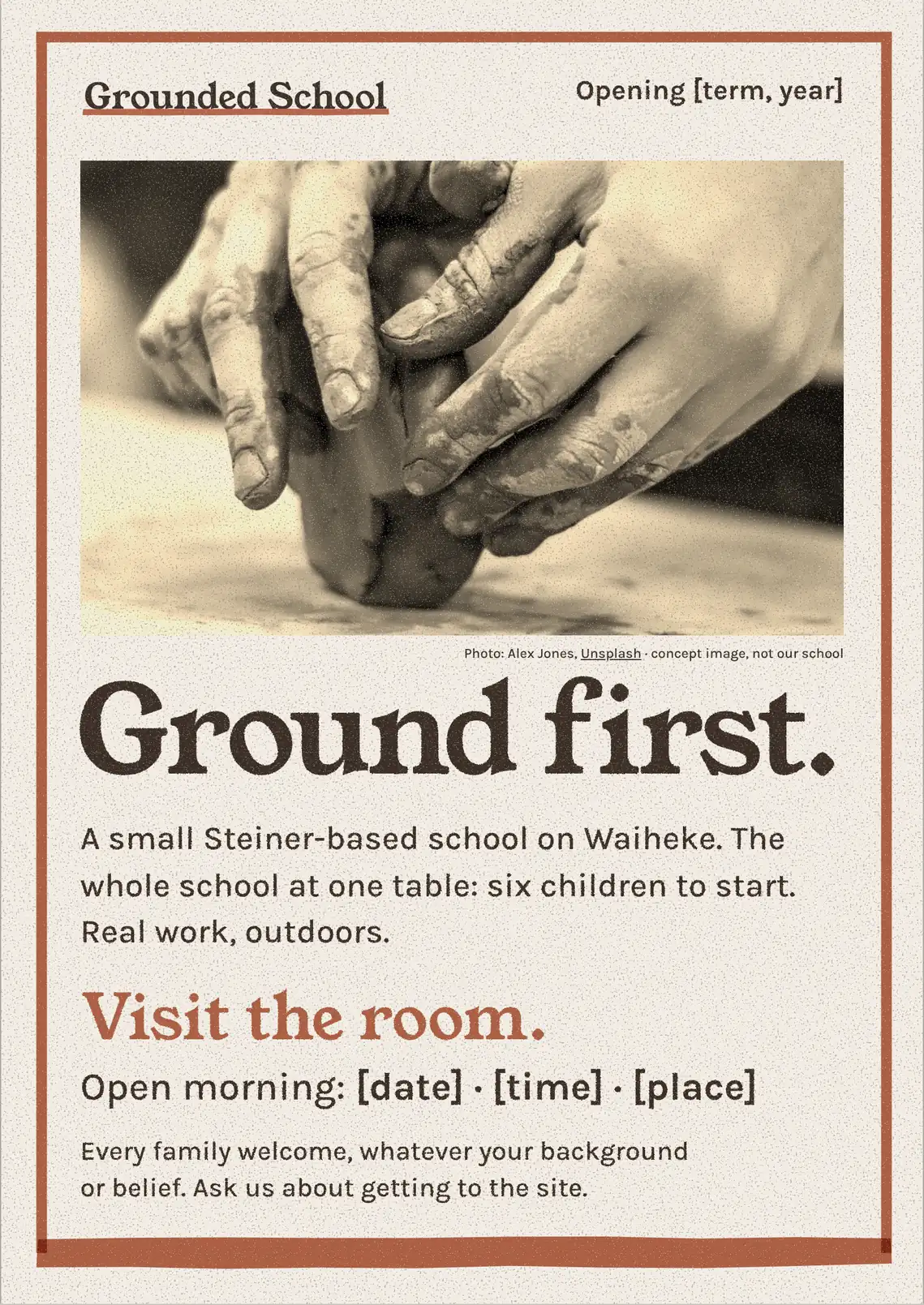
Grounded School A2 poster: Ground first. Bring your boots.
A2 poster420 × 594 mm, portrait. Select the poster for the full-size file.
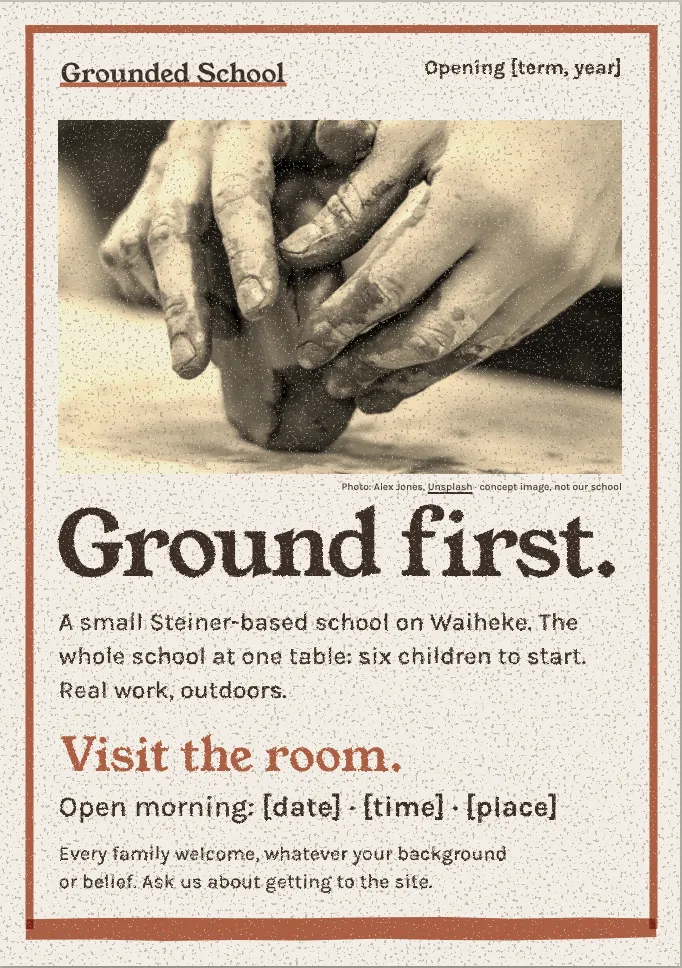
Grounded School A5 flyer: Ground first. Bring your boots.
A5 flyer148 × 210 mm
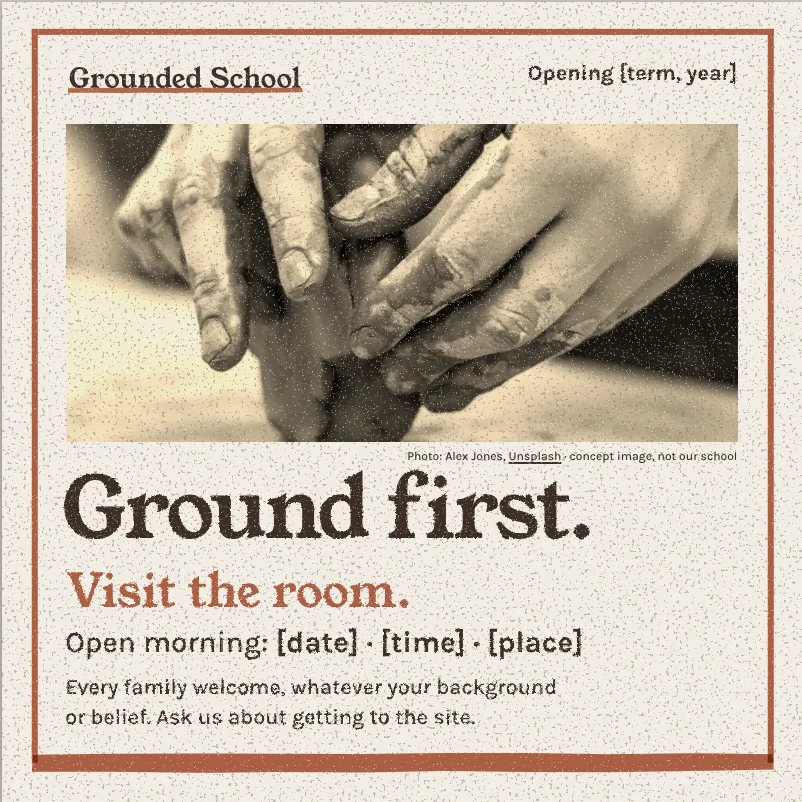
Grounded School square social tile: Ground first. Bring your boots.
Square tile1080 × 1080 px
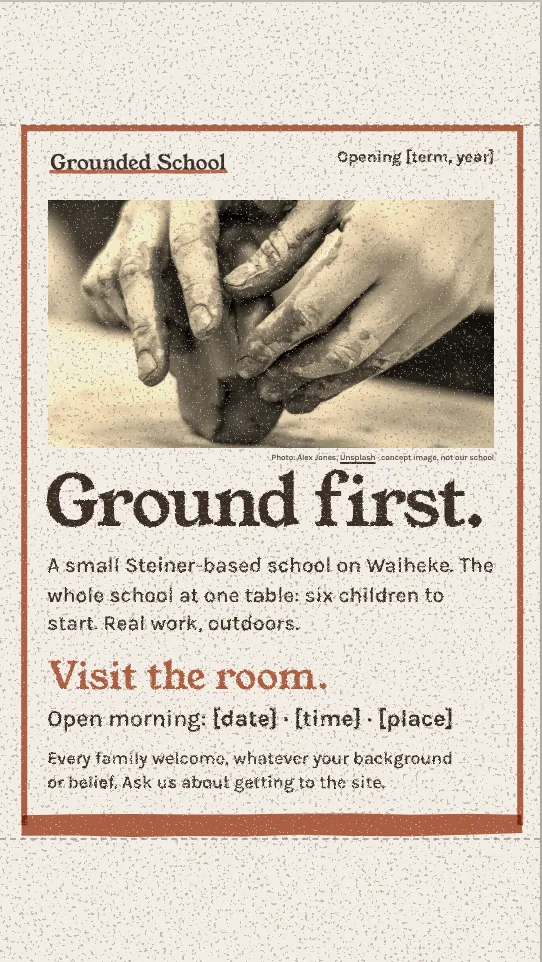
Grounded School story format, 1080 by 1920: Ground first. Bring your boots.
Story1080 × 1920 px
Headline
Ground first.
Sub-line
A small [Steiner-based] school on Waiheke. The whole school at one table: fewer than ten children. Real work, outdoors.
Call to action
Bring your boots. Open morning:
Event line
[date] · [time] · [place]
Who we welcome
Every family welcome, whatever your background or belief. Ask us about getting to the site.

The image areas are art-directed placeholders for a commissioned photograph. Placeholders in brackets are not yet confirmed.

08

Homepage concept

Desktop preview (1280 px wide)
Mobile preview (390 px wide)

The homepage carries a “decided / still confirming” panel and a status line, so a parent can see what is confirmed and what is still being set up. Placeholders in brackets stay visible on purpose.

09

Risks and open questions

These are the open risks and conditions on this concept, as recorded in the working papers. They are shown so that nothing is hidden before the vote.

Naming screen

Potential (weak or crowded), not a knockout.

  • No school, early-learning centre or provider called “Grounded School” appeared in NZ or AU searches.
  • “Grounded” is a busy word in NZ commerce (an impact-sector packaging brand, an Auckland charity, construction firms), so a trade mark would protect only narrowly.
  • Coffee and wellness classes were not verified. In everyday use “grounded” also means “punished”.

This is a preliminary knockout screen, not a clearance search. The official registers (IPONZ, IP Australia, Companies Office) were not queried, so no name is cleared. A licensed trade mark attorney must check any name before it is adopted.

Source: preliminary screening, searches dated 5 Nov 2026.

Linguist and cultural vetoes

  • NO VETOGROUNDED (name). Risk: Low–moderate.
  • NO VETOGround line (Route A device). Risk: None–low.
  • VETO (conditional): lifts only on cultural adviceSpiral or koru-like form in any wordmark, symbol or pattern. Risk: Severe if used without advice.

Conditional vetoes cover how te ao Māori is used, not the English names. They lift only when the named condition is met, and they cannot be overridden by the creative team or the project lead.

Source: linguistic and cultural check, 5 Nov 2026.

Council risks

  • Steiner stereotype: moderate. Clay, bread and handwork are core Waldorf imagery. That is acceptable because it is shown as work, but beeswax and wooden-toy props would tip it over VA.
  • Cultural: low. The ground line stays clear only while the copy never ties it to whenua or Papatūānuku ANTH.
  • Social: the punishment sense of “grounded” is the real risk for parents whose children struggled in mainstream school. Test it with that group, not only with children SOC.
  • Conceptual: “Learning stands on something real” treats the ground as an inert foundation. That is the weakest reading of the metaphor BIO PHIL.

Source: Creative Council report (advisory only), 5 Nov 2026.

Factual corrections to the metaphor

  • Ecologically, ground is not a foundation. It is made by living things: worms, fungi, decay. “Stands on” is fine as plain speech. A route about the ground should not imply that the ground is static. (Darwin’s last scientific book argued that much of the topsoil passes through earthworms; see references.)
  • ”Clay in the bank” and “the soil in the garden” depend on the site: [to confirm: site]. Waiheke soil type for the actual site: [data needed].

Source: Creative Council report, biologist’s read.

Claims still “OK once” (22 for this concept, including shared lines)

These lines stay in the mock-ups with their placeholders visible. None may be printed or published until the evidence is on file.

Show all 22 lines, with the evidence each one needs
  • S4”one teacher who knows each of them, and the land just outside the door”Status: OK once the teacher, staffing model and site are confirmed
    Evidence needed: Teacher appointed; adult-to-child ratio; site plan showing outdoor space next to the room
    Fallback: Fallback, as the platform notes already propose: “...and the land as part of every day.” Use it only once outdoor time is on the timetable.
  • S5”The whole school at one table”Status: OK once the descriptor and furniture are confirmed
    Evidence needed: (a) The legal pathway allows “school” (s 214; counsel). (b) The room and one table seat every child and adult.
    Fallback: If “school” cannot be used: “Everyone at one table” (as the verbal identity notes already set out).
  • S9”families are known in the room, not just at the gate”Status: OK once a family involvement rhythm is decided
    Evidence needed: Founder decision on how families take part (the platform notes mark it ASSUMPTION)
    Fallback: None while internal.
  • S10Inclusion statement “in line with the Federation’s published position”Status: OK once a person re-verifies the Federation statement
    Evidence needed: Read the Federation’s statement and record it with a date. Client copy never names the Federation.
    Fallback: None.
  • S11”[Steiner-based]”Status: OK once three conditions are met
    Evidence needed: (1) The Federation and a trade mark adviser clear use of the term. (2) A substantive basis: the teacher’s Steiner training is documented, or there is a written curriculum plan. Clearance of the word alone is not enough. (3) No line implies Federation membership or endorsement.
    Fallback: Fallback if not cleared: “drawing on Steiner education” in body copy only, never in a name or headline. If that is also not cleared, describe the practice without the term: “main lesson, rhythm and handwork”.
  • A2”Children dig, carry, knead and build. Every day.”Status: OK once the timetable is confirmed
    Evidence needed: Timetable with a daily practical-work block; site with ground that can be dug
    Fallback: None. Add S12’s status line wherever the line is used.
  • A3”Clay before letters, stones before sums.”Status: OK once the teacher confirms the curriculum sequence
    Evidence needed: Written curriculum outline from the teacher
    Fallback: None. If formal literacy starts later than in state schools, the “What about later?” answer must say so (see A20).
  • A4”the whole school, fewer than ten children, at one big table”Status: OK once S3 and S5 are cleared
    Evidence needed: Cap; descriptor; furniture
    Fallback: None.
  • A5”Out to the garden”; “the soil in the garden, the clay in the bank”; “a teacher you can know”Status: OK once the site and teacher are confirmed
    Evidence needed: Site plan showing a garden (and a clay bank, if it is named); teacher appointed
    Fallback: If there is no garden: “Out on the land.” Drop “the clay in the bank” unless it exists.
  • A8”A small [Steiner-based] school on Waiheke.”Status: OK once the pathway and S11 are cleared
    Evidence needed: Legal pathway (s 214); counsel clearance to use “school” before registration
    Fallback: If not cleared: “A small [descriptor to confirm] on Waiheke.”
  • A9”Real work, outdoors.”; “real work outdoors every day”Status: OK once the timetable is confirmed
    Evidence needed: Published timetable with a daily outdoor block and minutes per week; wet-weather plan; site access
    Fallback: None. Do not print until the timetable exists.
  • A10”Every family welcome, whatever your background or belief. Ask us about getting to the site.”Status: OK once the open-morning venue’s access is confirmed
    Evidence needed: Step-free access, or an access note, for the open-morning venue. The poster invites people to a visit, not to enrol.
    Fallback: If the venue is not step-free: “Every family welcome, whatever your background or belief. Ask us about getting to the site.”
  • A11Main lesson “for a few weeks at a time”; “play outside, in most weather”; handwork “Practised a little every day”; “back out on the land”Status: OK once the teacher and timetable are confirmed
    Evidence needed: Teacher’s day plan; timetable
    Fallback: None.
  • A12”Fewer than ten. The whole school at one table. No back row.”Status: OK once S3 and S5 are cleared
    Evidence needed: Cap; furniture
    Fallback: None.
  • A13”Ages together. Older children show how. Younger ones ask why. Everyone does both.”Status: OK once the ages are confirmed
    Evidence needed: Confirmed age range with a real spread (the brief says 5–12 is only a working range)
    Fallback: None, with the S12 status line.
  • A15”Trained as a Steiner teacher at [institution], [year]”Status: OK once a document is sighted
    Evidence needed: Certificate or transcript sighted by the founder. Teaching Council registration is named only if it is held.
    Fallback: None. Never imply registration.
  • A19”We reject them, plainly. Every child here stands on the same ground.”Status: OK once the founder signs the statement as the school’s own
    Evidence needed: Founder approval of the inclusion statement
    Fallback: None.
  • A21”We’re working through [pathway] with the Ministry of Education.”Status: OK once the founder confirms that contact with the Ministry has started
    Evidence needed: Record of the application or contact
    Fallback: If contact has not started: “Not yet. We’re preparing to apply for [pathway, to confirm]. We haven’t applied yet, and we’ll say here when we have.” If the pathway does not involve the Ministry, name the right body.
  • A22”If cost is the thing stopping you, ask us anyway.”Status: OK once the fee and access policy is confirmed
    Evidence needed: Written fee policy, including any support
    Fallback: If there is no support scheme: “Fees are [amount, period]. We don’t have a fee support scheme yet. If that changes, you’ll read it here first.”
  • A23”Not in the classroom...”Status: OK once the adults’ phone policy is written
    Evidence needed: Policy on adult phone use for safety and admin
    Fallback: None.
  • A25”[Teacher name], who reads every one...”; “Wear shoes that can get muddy.”Status: OK once the teacher is appointed and the open-morning plan is set
    Evidence needed: Teacher appointed; open morning includes time outdoors
    Fallback: None.
  • A26”Grounded School · Waiheke Island”Status: OK once the descriptor is cleared
    Evidence needed: Pathway
    Fallback: “Grounded · Waiheke Island · Ground first.”

Source: claims check, 5 Nov 2026. Most of the evidence depends on five founder answers: the legal pathway, the cap, the site, the timetable with hours outdoors, and the fee and access policy.

Other concepts

Back to all concepts